
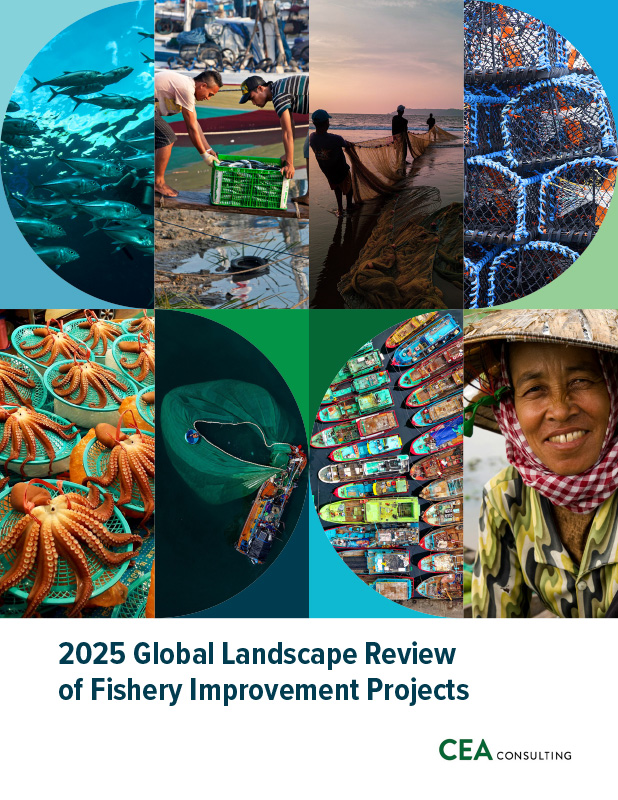
In the five years since CEA’s last global review, the landscape of fishery improvement projects (FIPs) has diversified across goals, geographies, commodities, and the political contexts in which they operate.
The 2025 Global Landscape Review of FIPs examines quantitative FIP landscape data, insights from over 200 expert interviews, and dozens of articles and reports to analyze how FIPs have evolved since 2020, including the impacts they create, the drivers of FIP success, and the shifting landscape of FIP finances.
Building off the 2015 and 2020 reports, the David and Lucile Packard Foundation, Walton Family Foundation, and the Gordon and Betty Moore Foundation commissioned the 2025 study to support funders and the FIP community to understand the current state of FIPs worldwide and how conditions and effectiveness may have shifted since CEA’s first report a decade ago. The report was authored by CEA Consulting, and builds on data and findings surfaced by CEA Consulting’s 2020 Global Landscape Review and 2015 Global Landscape Review.
The full report and the 2-page Funder Memo are available in English. The Executive Summary is available in Bahasa, Chinese, English, French, Japanese, and Spanish.
Key findings include:
- The landscape of FIPs has diversified dramatically across criteria such as geographies, species, the engagement of small-scale fisheries, types of implementers, and end goals.
- The number of active and completed FIPs has plateaued and may be declining for the first time.
- FIPs can drive progress by improving participant coordination and data quality, which can lead to policy change; however, challenges with assessing and demonstrating change on the water remain.
- Infrastructure for FIP reporting and implementation has grown significantly since 2015 but gaps and inefficiencies prevent effective impact measurement.
- Sustainability objectives and FIPs are now one of many other responsible buying priorities that buyers must balance within an increasingly complex regulatory environment.
- FIPs have expanded to address broader social responsibility concerns; while they have made meaningful strides towards advancing social equity, FIPs remain ill-equipped to uphold human rights.
Downloads

If you have questions or feedback about the report, please contact CEA Consulting at FIPs@ceaconsulting.com. Submit the form below to receive FIPs-related updates by email.